Opening Times

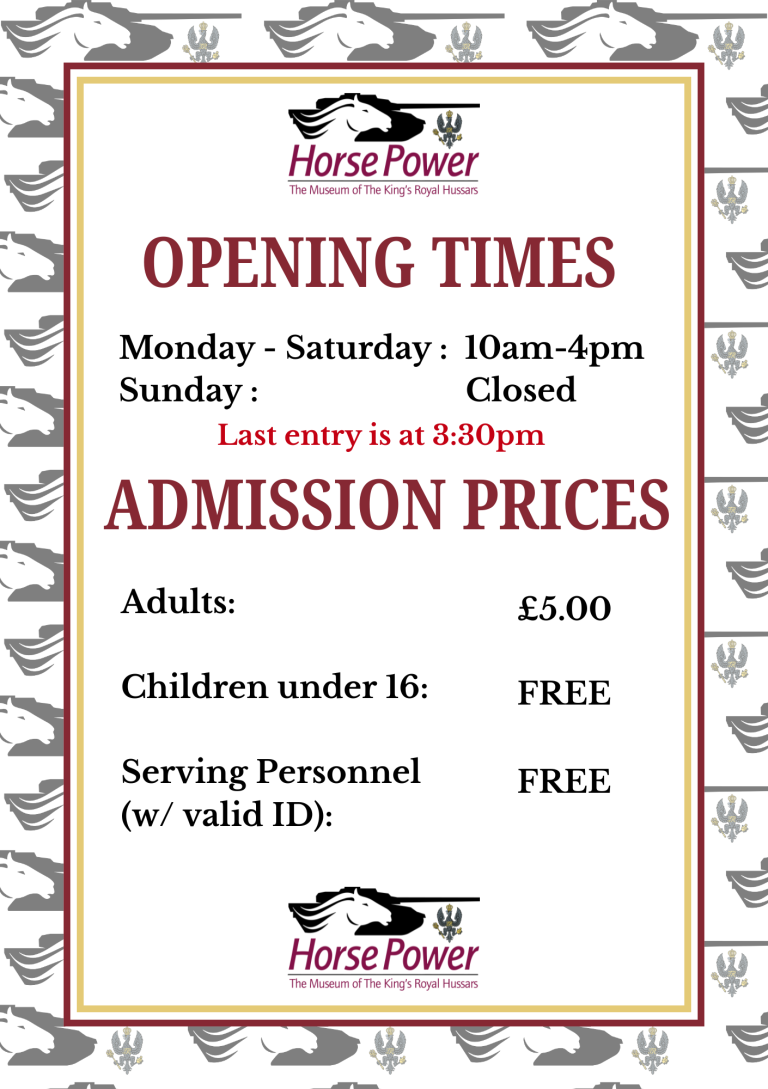
Tuesday to Friday:
10am - 12.45pm
& 1.30 - 4pm

Weekends & Holiday Mondays:
12 noon - 4pm

Admission is free

Welcome to the Museum of The King's Royal Hussars

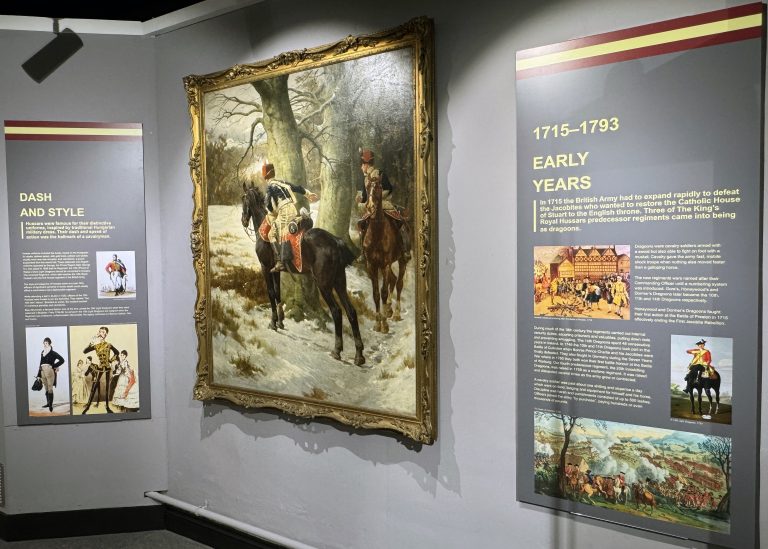
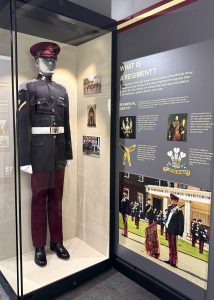
Visit HorsePower, the Museum of The King’s Royal Hussars, with its stunning displays of life size models, inter-active exhibits, medals, swords, magnificent uniforms and fascinating photographs which show how the Cavalry of horse and sabre developed into the modern armoured regiment of today.

Trace the history of three famous regiments over a period of 300 years and marvel at the great heroes who won the Victoria Cross for their valour.  The dramatic exploits of men who fought in the Peninsula War, the Charge of the Light Brigade, the two World Wars are revealed and much more besides.

You will find all of this in Hampshire’s only museum of Cavalry, located within the grand setting of Peninsula Square, Winchester, a site full of military heritage.


Museum Highlight


The Battle of Quatre Bras, 16th June 1815

01 Feb 2007. OC, 2IC, CSM of C Coy 3 RIFLES on Formation Day in Helmand.On Thursday 15th June, 1815, the Emperor Napoleon, having returned from exile in Elba, had seen the restored French King, Louis XVIII flee Paris; Napoleon’s armies then crossed the border into Belgium, by which time his old foe, Wellington, had established his headquarters in Brussels.

Napoleon’s plan was to bring his British and Prussian enemies to battle before their armies could join: two wings of his army would defeat the Prussians while Marshal Ney held the strategic cross roads at Quatre Bras (south of Brussels) to prevent Wellington joining the Prussians.

Ney’s troops were to seize the cross-roads on the afternoon of the 15th but for some reason failed to do so. Polish Lancers arrived but finding the junction deserted, decided not to stay. Shortly after an officer on Wellington’s staff arrived and, realising the importance of the area, assembled a small force to protect it.

Overnight, British forces assembled in preparation for battle. Napoleon began his attack on the Prussians at Ligny while Ney was to assault Quatre Bras. Inexplicably, Ney hesitated and his attack did not begin until late morning, by which time strong British forces had arrived.

01 Feb 2007. OC, 2IC, CSM of C Coy 3 RIFLES on Formation Day in Helmand.The 11th Dragoons were the first British cavalry to depart for the battle. At the start of the day they were 45 miles distant; when news of the battle arrived they were in undress uniform for a normal day’s work.  Immediately news arrived they set off.

After about 20 miles the sound of battle could be heard, and smoke seen. After 25 miles the horses were allowed a rest but passing wagons with wounded told the story – the regiment pressed on: According to one witness: “The cannonade mixed with the sharp rattle of musketry now became louder, while wagons and wounded were passed, poor fellows they bore themselves nobly in their pain, cheering us lustily and shouting, ‘Push on, push on, you are very much wanted as there are no cavalry up.’ And we did push on, as fast as our jaded animals would go; but all our efforts failed to bring us to the field in time to take part in the action.”

The 10th Hussars also rode to the guns but they, too, were too late. However, the Tenth still had a part to play. A detachment from the regiment, under Major the Hon Frederick Howard, was put out in front of the army on the night of the 16th. No news had been received from Marshal Blücher’s Prussians and the situation was most unclear.

Wellington arrived on the morning of the 17th and sent a patrol from the Tenth, under Captain Grey and Lieutenant Bacon, with a staff officer, Lt Colonel the Hon Sir Alexander Gordon, to make contact with the Prussian army. The patrol set off towards Namur, and after a short while ran into a French patrol. The French quickly retired, leaving Grey and his men to carry on.

Eventually, they stumbled across the Prussians, retreating from Ligny, where they had been defeated by Napoleon. Gordon spoke with General Graf von Zieten who commanded the Prussian rearguard, and took the news back to Wellington. At the same time another patrol from the Tenth, under Captain Wood, also made contact with the Prussians; both Grey and Wood can claim credit for alerting Wellington to the defeat of his ally.

The stage was now set for the following day: the Battle of Waterloo was about to begin. Both the 10th Hussars and the 11th Light Dragoons were ready for that momentous day.